


Welcome to Enviro Wash SA Water Solutions
One of the most important factors which contribute to a healthy society is a freely available and clean water supply.
The business serves customers through its distribution network of direct sales and distribution partners. Learn more about our products in your area by selecting one our market leading brands below.
Wash Bay Water Recycling

Wash bay water recycling systems allow for effective and sufficient effluent separation that allows for hydrocarbons (Oil, Diesel & Petrol) and filtration of final water through various filtration media to supply final water fit for re- use in washing operations. Some compounds, such as highly chlorinated compounds, heavy metals, and radionuclides are not readily biodegradable. Wash Bays water treatment plants are specially designed to the client’s requirements and vehicle types.
Wash bay waste water treatment is a cost-effective process and is designed to reduce the water demand on the main municipal supply.
Biological waste water treatment

Biological treatment using aerobic activated sludge process has been in practice for well over a century. Activated sludge process is a proven biological wastewater (sewage) treatment commonly used for the treatment of both domestic and industrial wastewaters. It is particularly well suited for treating waste streams high in organic or biodegradable content.
The treated effluent can be utilized for several reclamations uses such as agriculture, irrigation, or can be discharged to the environment. Plants are designed to either comply to SA Special Limits or General Discharge Limits dependent on requirements.
Oil / Water Separators
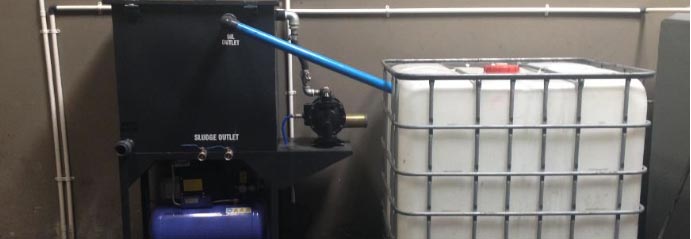
Separators are gravity separation devices designed by using Stokes Law to define the rise velocity of oil droplets based on their density and size. The design of the separator is based on the specific gravity difference between the hydrocarbon and the waste water because the difference is much smaller than the specific gravity difference between the suspended solids and water. Oil water separators purpose is to recover hydrocarbons that have segregated from emulsion in a gravity waste water separation plant.
Sand Oil Grease Separators

Sand Oil Grease Separators are below ground tanks designed to capture dirt, sand, sludge, minor petroleum spills, etc. from vehicle maintenance facilities to keep these substances out of the wastewater system. The separator treats these wastes by allowing substances lighter than water (such as oil) to float and substances heavier than water (such as sand) to sink.
If the sand/oil separators are not pumped frequently enough, the heavier dirt, sand, sludge and/or the lighter oil and grease will occupy too much space in the tank and be siphoned through the outlet pipe to the wastewater system. If the separator is not maintained property wastes can also cause a blockage and/or odor problem.
Rain Water Harvesting
Considering the acute problems of water scarcity that many are likely to face in the near future, it would seem prudent not to ignore the direct exploitation of nature’s simplest and most fundamental source of renewable freshwater – rain (Gould & Nissen-Petersen, 1999).
Rainwater harvesting is one of the simplest methods of self-supply of water. Rainwater harvesting includes the collection, capture and storage of rainwater for various purposes, including irrigation and domestic use. Rainwater can also with a properly designed system be used to supply portable water.
Rainwater harvesting can cut down on your monthly water bill by reducing water demand on public water systems reducing your water and sewer charges. It will also ease stress on the environment as the demand on our few water resources will be reduced.
Setting up a Rainwater harvesting system at homes or at work is a simple installation with materials such as plastic water tanks and PVC pipes.
Water Treatment

Clean, safe water is vital for everyday life. Water treatment is any process that improves the quality of water to make it more acceptable for a specific end-use suck as drinking water, industrial water supply, irrigation and various other uses. Water treatment removes impurities or reduces their concentration so that the water becomes fit for its end-use.
The water treatment process may vary slightly at different locations, depending on the technology of the plant and the water it needs to process.
Filtration
Water flows through a filter designed to remove particles in the water. Filtration collects the suspended impurities in water and enhances the effectiveness of disinfection. The filters are routinely cleaned by backwashing and replacement. Types of water filtration include Reverse Osmosis, Nanofiltration, Ultrafiltration, Micro filtration and Particle Filtration.
Disinfection
Water is disinfected to ensure that any disease-causing bacteria, viruses, and parasites are destroyed. Ultraviolet systems (UV) use Ultraviolet light to disinfection in water where Ozone is the creation of oxygen into ozone with the use of energy.